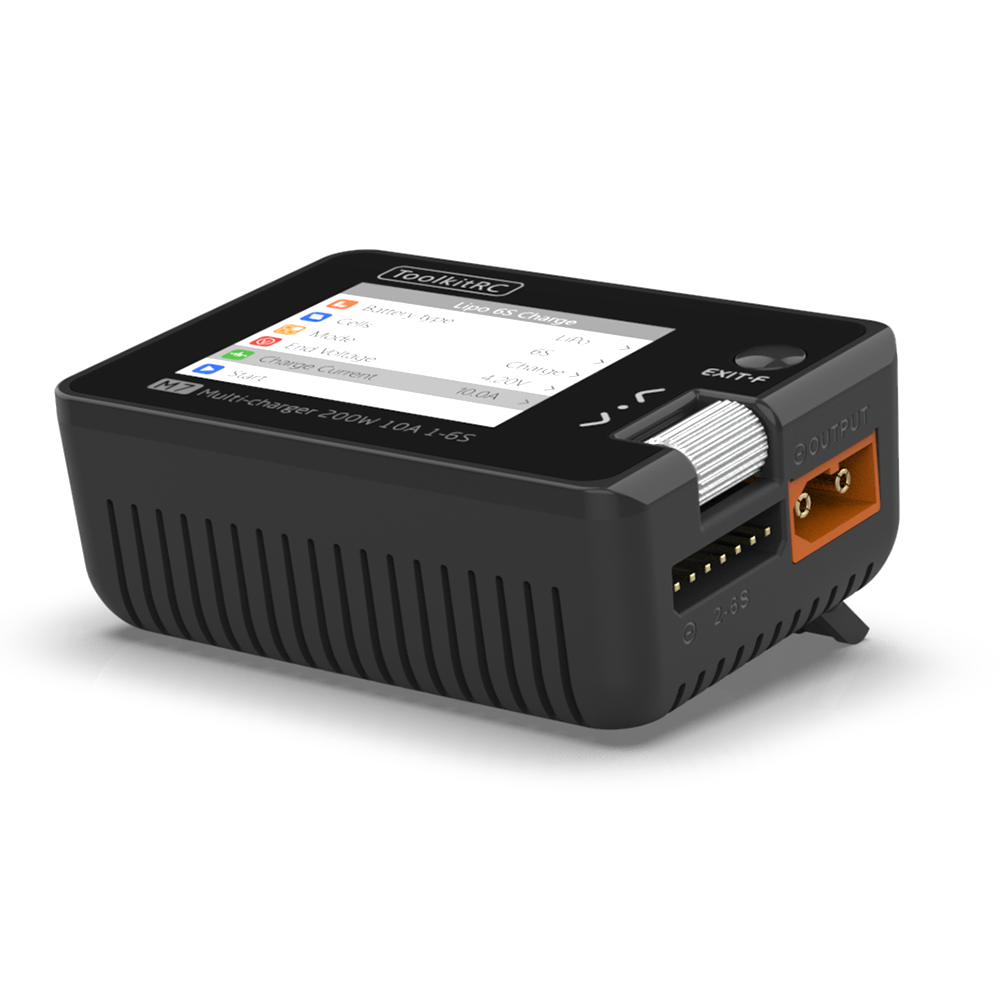
ToolkitRC M7 200W 10A
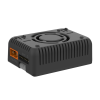
ToolkitRC M7 is a compact single-channel charger without an integrated power supply for 1-6S LiPo, LiHV, LiFe and Li-ion batteries, 1-16S NiMH and 1-10S lead-acid batteries. It is the successor to the popular M6 charger: with the same dimensions of 73x51x27mm and a weight of 90g, it delivers one-third more power. It charges at up to 200W and 0.1-10A, enough for full charging of 6S batteries as well as parallel charging of smaller packs, while fitting into a backpack pocket, making it suitable as a main charger for both the workshop and the field.
The charger does not have an integrated power supply and is powered via XT60 by 7-28V DC voltage (max. 12A) from an external power supply or a larger battery, such as a 6S LiPo or car battery. When powered from a battery, it provides regenerative discharge („recycle“) at up to 200W (10A), returning energy from the discharged battery to the input battery; it can also discharge at the same power into an external load connected to the input. Internal heat dissipation is only 10W (3A), so it is better suited for bringing batteries into („storage“) mode than for fast discharging. For lithium packs, it has a balancer with 400mA current (2-6S) and accuracy below 5mV, supports adjustable cell end voltage (TVC) and storage mode, and measures cell internal resistance in the 1-100mΩ range. It also has a mode for smart drone batteries („smart battery“), which must be activated before charging.
The charging status, including voltage and internal resistance of individual cells, current, power, charged capacity and time, is displayed on a colour 2" IPS display with 320x240px resolution, clearly readable even outdoors in daylight. It is controlled with a scroll wheel and one button.
In addition to charging, it serves as a diagnostic tool for FPV electronics: via servo pins, it measures PWM, PPM and SBUS signals (e.g. for checking receiver output) and also generates the same signals, functioning as a servo tester and ESC tester. It also works as a regulated power supply with adjustable 1-28V voltage and 1-10A current (CC+CV), with overcurrent protection responding within 5ms. The USB port on the back provides 5V/2.1A for charging a phone or camera and is used for firmware updates: the charger connects to a computer as a USB drive, where the new file is copied. The manufacturer continues to develop the firmware; newer versions have added lithium battery cycling, a custom battery type with 2-5V cell voltage, and sodium batteries. Protections monitor internal temperature, charging time and capacity, the fan activates according to temperature, and after charging is complete, the charger can automatically continue with the same settings for the next connected battery.
Hauptmerkmale
- Supported batteries: LiPo / LiHV / LiFe / Li-ion 1-6S, NiMH 1-16S, Pb 1-10S
- Charging power: 200W
- Charging current: 0.1-10A (0.1A increments)
- Number of channels: 1
- Discharge power: 200W regenerative (recycle, only when powered by a battery) or into an external load / 10W internally
- Discharge current: 0.1-10A recycle and external / 0.1-3A internal
- Balancing current: 400mA (2-6S)
- Accuracy: <5mV
- Internal resistance measurement: 1-100mΩ
- Modes: Charging, discharging, storage, cycling (NiMH), adjustable end voltage (TVC), smart battery, regulated power supply 1-28V / 1-10A
- Signal tester: PWM / PPM (8 channels) / SBUS (16 channels) measurement 880-2200µs, 1-6S cell voltage measurement
- Signal generator: PWM 500-2500µs (20-1000Hz) / PPM 8 channels / SBUS 16 channels, servo and ESC tester
- Input voltage: 7-28V DC (max. 12A)
- Input connector: XT60
- Output connectors: XT60 + 2-6S balance connector, servo pins for signals
- USB output: 5V/2.1A (device charging, firmware update)
- Display: IPS 2" 320x240px
- Size: 73x51x27mm
- Weight: 90g
Die Handbücher
Inhalt
- 1x Charger
- 1x USB cable
- 1x Quick guide
- 1x Display protective film